Monday, March 8, 2010

Dan Pratt Organ Quartet - Toe the Line (Posi-Tone)

The Hammond organ is a hardy instrument, having weathered waxing and waning popularity since pioneers like Fats Waller and Bill Doggett brought it prominence as a viable jazz voice. Still, the number of players who opt to apply it to adventurous settings remains relatively few compared to the legion content to toe the line of convention. Saxophonist Dan Pratt and organist Jared Gold choose the less traveled path on this second disc by Pratt’s working quartet. Gold is an important part of a recent release by guitarist Jeff Stryker also reviewed in these virtual pages. The difference in his playing in that context compared to here is instructive as to just how well Pratt is able to press the best from his partners by giving them plenty to work with.

Pratt’s writing for the band is its principal asset. Each of the nine originals brims with ideas and novel avenues for execution. “Houdini” and “Minor Procedure” work of tightly wound heads and bright, bustling rhythmic structures. Gold builds throbbing bass lines and whirring fills that make the most of his instrument’s variable tone settings. “Wanderlust” opens with syrup-thick sustain and weirdly warbling effects that instantly place the tune apart. On “Star Crossed Lovers” and the closing “After” Gold traffics in luminous, church-appropriate swells that resist tipping over into treacle. The Brothers Ferber, Alan on trombone and Mark on drums, complete the band and are equally essential to the constantly shifting sound that reflects the players in nearly all manner of component groupings. Alan works like the cooling balm preceding the burning heat of Pratt’s improvisation on “Dopplegänger”, his rounded lines transmitting with an almost tactile smoothness.

Other pieces in the program cover different bases from the rock-inflected patterns of the title piece that works off another monster snaking bass line from Gold and a string of dynamic drum breaks to the vaguely Latin groove of “Stoic”, which again features the unflappable ingenuity of the drummer’s textured stick play. Trading in humor and tradition, “Uncle Underpants” gains momentum as a spiraling Pratt-penned head irons out into a stomping funk vamp. Ferber’s malleable backbeats soon reach street band fervency and he virtually steals the track with a galloping extended break. Pratt and his colleagues have been gigging quite regularly and the multiple merits of this release are certain to extend that employment streak. It’s a set custom-designed for skeptics who consider organ dates strictly old hat.

Friday, March 5, 2010

Jean-Michel Pilc - True Story (Dreyfus)

Possessing a technique suggestive of years of rigorous training, French pianist Jean-Michel Pilc is actually an autodidact. His self-honed skills at the keyboard are immediately impressive and evince Bill Evans impressionism by way of Keith Jarrett and Chick Corea. His left hand is very nearly as mighty and variable as his right allowing for overlapping runs of dizzying density and detail. Free playing in systemic manners akin to Michel Pettruciani and early Cecil Taylor also falls with in the scope of his oeuvre. Name-dropping carries over onto his “dance card” since moving to New York City in 1995, as he’s gigged with dozens of high profile players over that period. All of this looks exceedingly good on paper, but Pilc oddly leaves me cold as a pianist. He has since I first caught him in person at the Iridium five or so years ago in a performance that felt more flash than substance.

His latest trio effort for Dreyfus does little to change my admittedly counter-intuitive opinion. Regular sideman Boris Kozlov joins drum doyen Billy Hart as Pilc’s sidemen and their roles point to one of my chief problems. Pilc is in command of his instrument to a fault on occasion. He takes his positioning to practice, playing the hell out of keys but only rarely allowing his partners what sounds like equitable input into the pacing and direction of the pieces. Kozlov appears amenable to the dynamic, but consigning a player of Hart’s caliber to the figurative backseat almost seems an offense. Call it the Art Tatum Syndrome, though Tatum had the advantage of singularity of precedence to offset his tendency towards session monopoly.

The program is predictably Pilc-centric as well with only three of the pieces falling outside his compositional dragnet. He even customizes a Schubert tune to the occasion. The closing five-part title suite encapsulates the troublesome band differential as Pilc’s guiding patterns rise and recede between rumbling dissonance and lush lyricism. Hart and Kozlov dutifully follow the often two-handed forceful leads, but the dynamic feel vexingly out of balance much of the time, almost as if the pieces would’ve been better served in a solo setting. My stated biases aside, there’s still a fair amount of dramatically-charged playing here. It’s the part of Pilc’s powers that transcends my criticism and explains how he cultivated the enviable positioning he currently enjoys.

Thursday, March 4, 2010

Sharel Cassity - Relentless (Jazz Legacy Productions)

Despite the global proliferation of jazz, New York City remains the foremost proving ground for the music’s practitioners. Making it in the Apple still ostensibly means making it on the world stage. Classically trained, with diplomas from both the New School and Julliard, saxophonist Sharel Cassity’s credentials are not uncommon to the caliber of player competing for gigs. Cassity’s made the most of her residency by networking with a wide swathe of her peers. She convenes a cadre of their number on this leader date, running down a program dominated by her own compositions. Trombonist Michael Dease contributes a piece and the disc wraps with an arrangement of Charles Tolliver’s “On the Nile” that mirrors the instrumentation of its original Blue Note recording by Jackie McLean and the composer.

Wielding alto, soprano and flute, Cassity commands a warmly creative mien to each. Besides Cassity, the constant across pieces is the rhythm section headed by pianist Orrin Evans and completed by bassist Dwayne Burno and drummer E.J. Strickland. Dease is present on all but three tracks. Trumpeter Jeremy Pelt accompanies Cassity for three tunes including with the smoking hardbop numbers “Call to Order” and “No Turning Back”. Flugelhornist Thomas Barber and tenorist Andres Boyarsky join Pelt on the shifting-meter obstacle course “Song of Those Who Seek” as well as two other tunes in his absence. Capping off the guest list, saxophonist Don Braden fields alto flute and enhances tonal color on the Cassity original “Still”.

The round robin approach to personnel enhances the session variety while keeping Cassity on her improvisational toes. As effervescent and focused as the playing often is, there’s still something slightly quotidian about the date. The tunes are durable in construction, but there’s little in the way of memorable surprises in either their renderings or the solos they foster. Cassity’s career likely has many more years ahead so the need for a homerun isn’t urgent. Her priority for placing creative integrity ahead of probable financial gain also speaks to potential longevity. Listeners with a yen for tradition-savvy sounds will find much to their liking here though others may wish for more in the way of singularity.

Wednesday, March 3, 2010

Various - Boogie Woogie Kings (Delmark)

As an idiom, boogie woogie seems an ideal candidate for sampler consumption. That’s a polite way of saying that for many listeners, a little tends to go a long way. Rhythmic and melodic protocols tend to follow relatively rigid parameters and most purveyors aren’t usually known for their ability to straddle other piano forms. That hasn’t stopped the good folks at Delmark from continuing to dust off classic sides by the leading lights of the style. This latest collection lives up to its title in surveying six in that celebratory fraternity, all now sadly long since deceased.

Provenance for the selected pieces ranges from a pair of late 30s Chicago sessions by “Cripple” Clarence Lofton, who makes up in enthusiasm what he might lack in digital dexterity, to a trio of later comeback dates by the likes of nearly-expired brand names Speckled Red and Henry Brown. Compiler Bob Koester wisely sequences with an ear toward diversity in the musicians’ methods of delivery as well. Meade "Lux" Lewis doubles on celeste to create a calliope effect on “Dollhouse Boogie” and threads in some mellifluous mouth-puckering on “Whistlin’ Blues”. Speckled Red sounds a little worse for wear on his four numbers and turns in a rushed rundown of his secretly salacious “Right String But the Wrong Yo-Yo”. He redeems himself on a galloping boogie-woogie that bears his name with shoot-from-the-hip verse-play straight out of the riverside barrelhouse.

“Boogie Woogie Prayer” ups the ante on the time-honored custom of the boogie duel by adding Pete Johnson to the popular pairing of Albert Ammons and Lewis. While a bit of a demolition derby, it’s still great fun hearing the three men try to not gum up the underlying rhythm with their fast dancing, crisscrossing fingers. Lewis ends the set with a sound-muffled sally through his own “Closing Time” that’s apposite in title, but otherwise a shade anticlimactic. Running time for the nineteen cuts clocks at a conservative 53-minutes and change, but in a setting such as this that relative brevity is arguably an asset.

ROW: Colombie – Le Vallenato (Ocora)

Living in polka country, as I do, naturally necessitates a love of the squeezebox. My tastes run fairly wide when it comes to the instrument’s applications and some of my favorite sounds are those of the vallenato, a Columbian cumbia progenitor that pares participants down to the potent combo of diatonic accordion, caja (conical hand drum) and guacharaca (bamboo shaker). Later variations added horns and bass coming closer to modern cumbia forms, but this mid-90s Ocora set contains field recordings of some of the elders of the art form including Nicolas “Colacho” Mendoza, Antonio “Toño” Salas and others energetically running down sones, paseos, merengues and puyas in the aforementioned stripped down set-up. The crossweave of often improvised, oscillating accordion leads and polyrhythmic accompaniment is watertight and instantly infectious to listener limbs. Several interstitial cappella songs spice up the flow of the program with the vocalists shout-singing the refrains. The is dance music at its most unvarnished and propulsive, impossible to ingest without experiencing a subsequent imperative to shuffle and stomp the feet. If I won the lottery, a complete Ocora collection would undoubtably be among my initial expenditures. Until that day, I make do with the dozen or so I have, this one being at or near the top of the stack.


* I’m not normally one to trumpet download sites, but Purayuca is a must-stop for anyone even casually interested in vallenato: Dozens of classic LPs and CD reissues, which are crow’s teeth rare in the States including the Ocora above. Swing by there and tell me what you think...

Tuesday, March 2, 2010

Chris Kelsey - Not Cool (Tzazz Krytyk)

As playfully glib as ever, saxophonist Chris Kelsey couches his latest effort in an oppositional framework certain to arch a few eyebrows and maybe even roll a few eyes. His commentary to the disc commences with a caveat clarifying that his decision to sight Paul Desmond in his crosshairs isn’t strictly motivated by disdain. Sure, he still attaches signifiers like “sappy”, “wimpy” and “nerdy” to the much-lauded surname, but he’s also careful to concede the Caucasian altoist’s stature as “an accomplished and distinctive improviser”.

That’s where the compliments cease as virtually nothing on the album aligns with Desmond’s genteel sensibilities or singularly aerated style of improvisation. From start to finish, Kelsey and his colleagues favor fire-spitting free jazz fare of the sort that’s been idiomatic for nearly half a century. The saxophonist takes obvious pleasure in wrinkling and warping his delivery with liberal doses of raspy vibrato. One of his earlier sessions for CIMP carried the title The Crookedest Straight Line and that diametric phrase holds true here too, his dense patterns canting and slicing at sharp diagonals against the controlled rhythmic tumult generated by his regular confreres, bassist Francois Grillot and drummer Jay Rosen.

The date is also notable for a number of other reasons. First, there’s the presence of trumpeter Chris DiMeglio who boldly matches Kelsey in the frontline, doling out tonal unpredictability with a colorful array of brassy slurs and smears. Second, Kelsey’s addition of tenor and alto to his usual soprano playbook opens up fresh avenues of expression. His phrasing on the straight horn is curiously the cleanest of the three, the other two suggesting spiral staircases of oddly stacked phrases. The pieces follow similar schematics of knotty ensemble statements followed by bristling solos. Kelsey leaves little time for coasting and his puckish propensity is also present in the clever titles he hangs on the compositions (cf. “If Jazz is Dead (Can I Have Its Stuff?)). In a lone overt concession to the canon, the set signs off with a comparatively mellow stroll through Ayler’s “Ghosts” and the closest thing to Desmondian decorum on the date.

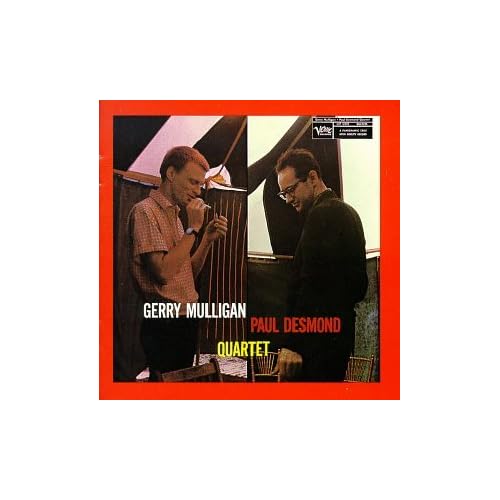
Kelsey is a provocateur in the best sense of the term: a player (and writer) who thrives on pushing buttons, but does so with both intelligence and an underlying respect for both the audience and art form he chooses to work within. It’s a thin tightrope to traverse sometimes and invites the occasional tumble, but Kelsey’s hardly one to wince at any resulting bruises. As enjoyable as this session is as a Desmond-antipode, I’m still half-inclined to airmail him a copy of Quartet and see if I can’t inveigle a revision in his opinion.

Monday, March 1, 2010

Kirk Knuffke - Amnesia Brown (Clean Feed)

Most familial histories include at least one black sheep forbearer, a member who marched to the beat of his own drum at the expense of his or her loved ones. Trumpeter Kirk Knuffke pays wry tribute to one such outcast of his clan on this latest Clean Feed release. The eponymous individual was a great grandfather who abandoned his family and started a new one in a neighboring town. Upon discovery, he cited the affliction as his reason for leaving and the nickname stuck. The story passed into hereditary lore and became a handy thematic source point for a trio project Knuffke had been trying to organize with fellow New York-based improvisers Doug Wieselman and Kenny Wollesen.

Their instrumentation distantly recalls Shelly Manne’s “The Three” with Shorty Rogers and Jimmy Giuffre, though clarinetist Doug Wieselman doubles on electric guitar rather than playing multiple reeds as Giuffre did and the resulting music is quite a different bag. Knuffke foregoes mutes, manipulating a highly malleable tonal palette with embouchure and valve effects instead. Wollesen is the rhythmic fulcrum, applying tenacious metered glue in daubs or full-fledged strokes depending upon the composition, all of which come from Knuffke’s quill. All three men are members of Butch Morris’ Nublu Orchestra and that large scale mindset to movement and color informs their small group interplay.

The sixteen compact pieces never stray over five minutes and most clock significantly shorter. They neatly divide along which axe Wieselman wields. Many of the clarinet pieces pivot on fluid counterpoint and communicate chamber associations as a result. The guitar tracks are often more rock-inflected in cast with Wieselman lathering on jangly reverb and carving out fanged arpeggios as he does on “Double”, “2nd” and “Hears It”. “Totem” sounds a bit like concentrated fusion-era Miles distilled of all distracting detours as quietly echoing plectral notes harden and intensify and a porous beat gradually consolidates into an incrementalized groove.

Knuffke remains his cool-toned, unruffled self in either context and his rounded, textured phrasing comes across like a cousin to other players like Tom Harrell and John McNeil. On clarinet pieces like the madrigal-minded “Practical Sampling” and the wobbly waltz-time “High-pants Bob” knotty heads allow for closely twining debate. Wieselman veers from heavy vibrato trills to birdsong chirrups and the variety again creates colorful contrast with Knuffke’s gliding lines. The lovely tone poem “Anne”, unfolding as an airy processional of simple construction, serves as an optimal closer. Amnesia really isn’t an option in the wake of these exciting sounds.